
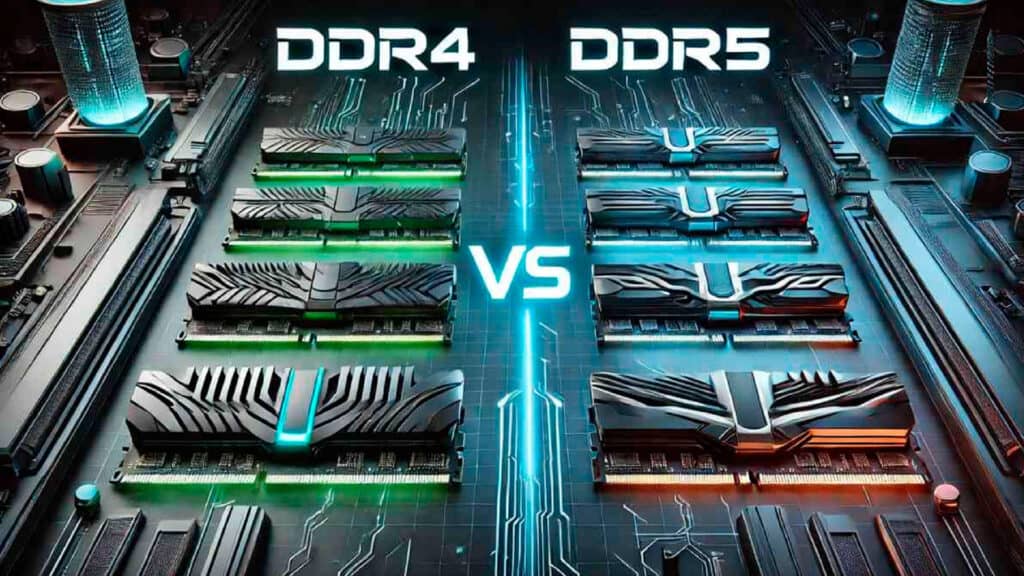
RAM is one of the most consequential hardware decisions your business makes — and in 2026, it’s also one of the most complicated. DDR5 memory has firmly displaced DDR4 as the platform of choice for new systems, yet DDR4 remains perfectly viable for millions of existing workstations. Meanwhile, a global DRAM shortage has pushed prices for both generations to historic highs.
This guide gives you the complete picture: what DDR4 and DDR5 each offer, how they compare in real business workloads, when it makes financial sense to upgrade, and where to get the best value on RAM for your Houston-area business or organization.
Understanding RAM — A Quick Primer
What Is DRAM and Why Does It Matter?
DRAM (Dynamic Random Access Memory) is the short-term working memory of your computer. Unlike storage (see our guide on SSDs vs HDDs), RAM holds active data for immediate CPU access. More RAM means more applications, browser tabs, and datasets can be held in memory simultaneously — directly impacting system responsiveness and productivity.
RAM speed determines how quickly data moves between the memory modules and the processor. While speed matters, for most business workloads, capacity typically has a greater day-to-day impact than raw MHz.
What Is the DDR Standard?
DDR stands for Double Data Rate. Each generation doubles the theoretical bandwidth of the previous one while introducing power efficiency improvements. DDR5 launched in 2021 and is now standard on all modern laptops and desktops built in the last three years.
DDR4 vs DDR5 — Head-to-Head Comparison
| Specification | DDR4 | DDR5 |
|---|---|---|
| Speed Range | 2133 – 3600 MHz | 4800 – 6400 MHz (and beyond) |
| Peak Bandwidth | ~50 GB/s (Dual Channel) | ~96 GB/s (Dual Channel) |
| Voltage | 1.2V Standard | 1.1V Standard (More Efficient) |
| Max Module Capacity | 32GB per DIMM (Typical) | 128GB per DIMM (Available) |
| Error Correction | ECC Optional (Server Grade) | On-die ECC Standard on all DDR5 |
| Platform Compatibility | Older Intel/AMD Systems | Intel 12th Gen+ · AMD Ryzen 7000+ |
Real-World Performance — What the Numbers Mean for Business
Office Productivity & Multi-Tasking
For standard office tasks — Word, Excel, Outlook, and browser-based networking applications — DDR4 at 16GB provides more than sufficient performance. The bandwidth difference between generations is essentially imperceptible in these workloads.
AI and Machine Learning Workloads
This is where DDR5 truly separates itself. On-device AI processing — including local LLM inference and machine learning training — is heavily memory-bandwidth-limited. For businesses building AI-powered workflows, DDR5 is the necessary foundation to prevent CPU bottlenecks.
Video Editing & Creative Production
DDR5’s bandwidth advantage becomes meaningful in creative production. Video editors working with 4K or 6K footage, motion graphics designers, and 3D artists using high-end GPUs will see material improvements in render times and project scrub smoothness.
Should Your Business Upgrade to DDR5 in 2026?
- You are buying a new workstation or laptop fleet.
- Your workload involves AI, data science, or 4K video.
- You need maximum longevity (5+ years).
- Your current DDR4 platform handles your tasks well.
- You need a cost-effective capacity boost (add more RAM).
- Budget constraints make new platforms prohibitive.
The 2026 RAM Shortage — Buying Advice
The DRAM market in 2026 is experiencing a supply crisis driven by AI infrastructure demand. Hyperscalers are consuming enormous quantities of server DRAM, pulling production away from consumer markets. Our recommendation: Buy the RAM you need now. Market signals suggest the shortage will persist through mid-2026, keeping prices volatile.
At Calderix Technologies, we maintain in-stock inventory of both DDR4 and DDR5 modules in common business configurations. Contact our team for current availability and bulk pricing.
Frequently Asked Questions — RAM 2026
Ready to Upgrade Your Office Performance?
Calderix Technologies · 1919 Taylor Street STE F, Houston, TX 77007
Expert Memory Upgrades for Small Businesses & Enterprise